The End of Traditional Digital Transformation: Enter the Intelligence-First Era
Enterprise AI adoption is rising, but value lags. Learn why digital transformation failed to scale intelligence and how intelligence-first design drives growth.
Enterprise AI adoption now exceeds 70 percent. However, less than one in five organizations says their AI initiatives have materially changed decision-making.
Investment continues to grow, but enterprise value often lags. Many leaders feel this tension daily as systems appear modern while intelligence struggles to operate at scale.
Digital transformation delivered efficiency and cloud-enabled operations. What it did not address was how intelligence moves, learns, and coordinates across the enterprise.
Static systems cannot adapt at the pace of market change. Tools can automate tasks, but they cannot think, learn, or coordinate across functions on their own.
Leaders must now rethink how intelligence flows through the enterprise so they can understand how systems are designed to respond to changes.
If you have been wondering how the intelligence-first era is reshaping the way enterprises compete, you are in the right place.
In this blog, we will explore why enterprises must move from digital tools to AI-driven intelligence. Keep reading to learn.
What Digital Transformation Got Right—and Where It Quietly Failed
Over the last decade, digital transformation has helped companies modernize quickly. Moving to the cloud has made operations faster and connected teams better.
It has made core workflows go digital, and automation has taken over many repetitive tasks. For many organizations, these changes brought real efficiency gains and faster time-to-market. It proved that investing in digital tools could deliver tangible results.
But here’s the catch. While tools improved processes, they didn’t change how intelligence moves across the enterprise. Data often remained in silos, and decision-making was slow.
Insights were available after the data arrived, but not in real time. Leaders began noticing that efficiency alone wasn’t enough. Growth, resilience, and true competitive advantage required a deeper shift.
Let's look at the real achievements of digital transformation and why even successful projects sometimes fell short.
The Real Achievements of Digital Transformation
Digital transformation did deliver results, and it’s worth recognizing them. Moving operations to the cloud made processes faster and more reliable.
Now, teams could work together across locations. It has made the workflows easier to track. Automation took over repetitive tasks, giving employees more time to focus on meaningful work.
Many organizations saw real gains in efficiency, cost savings, and customer experience. It has also created a foundation for smarter ways of working.
Modern data platforms made insights more accessible, even if they weren’t always available in real-time. Some companies even started experimenting with human-centric augmented intelligence. It helped their teams to make better decisions with smarter support.
Hence, the key takeaway is that digital transformation worked. However, it was ideal for improving processes and efficiency. Well, it did set the stage.
The next step is figuring out why these wins didn’t always translate into lasting enterprise impact.
The Rise of the Intelligence-First Era
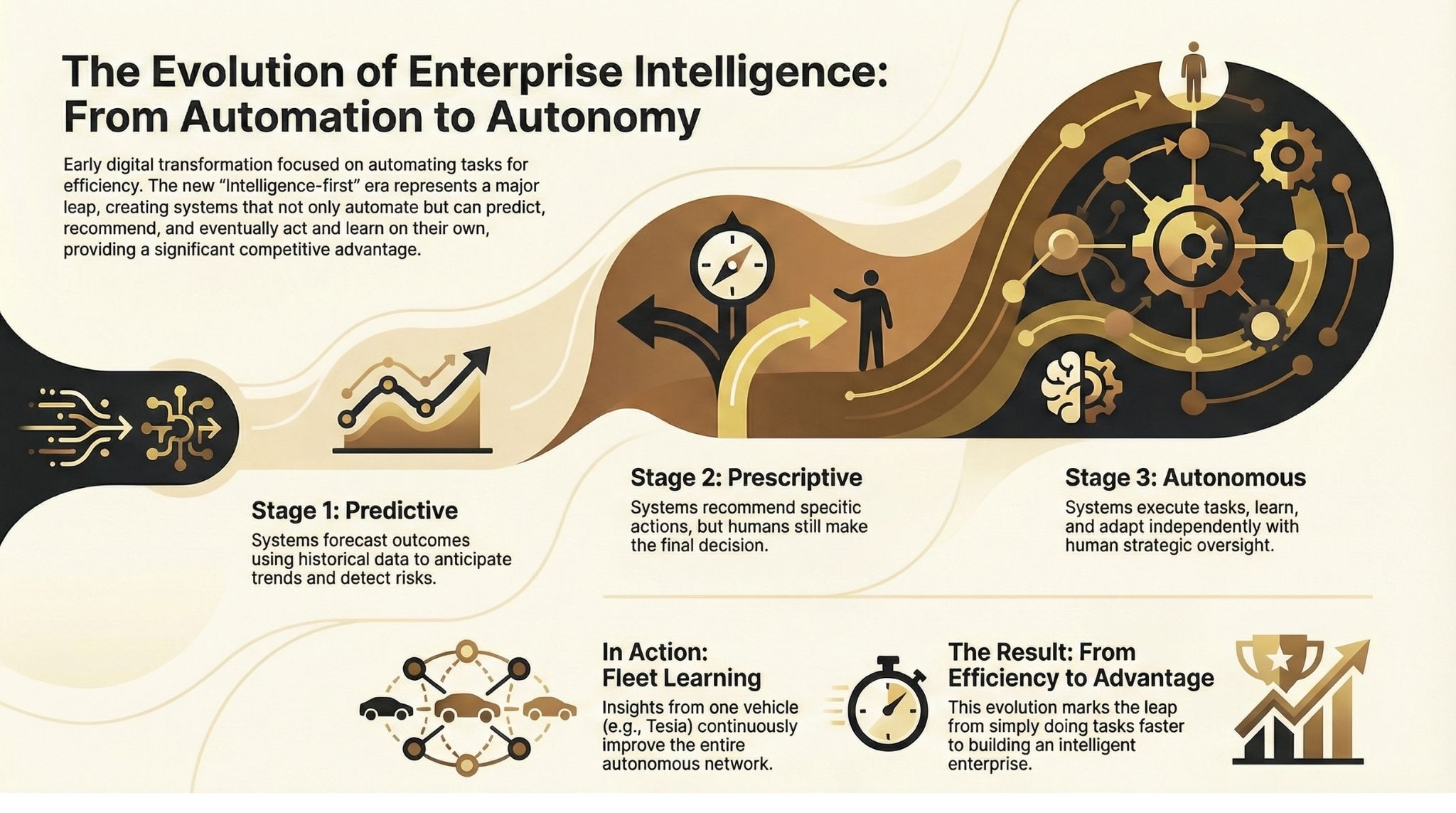
Digital transformation laid the groundwork, but the real shift is happening now. Organizations are moving from automating tasks to designing systems.
They can learn, adapt, and act independently. It is the beginning of the intelligence-first era. Here, decision-making, execution, and insights flow together seamlessly.
Leaders are realizing that operational efficiency alone cannot deliver resilience or exponential growth. The move toward intelligence-first requires rethinking enterprise design.
Predictive and prescriptive systems are giving way to autonomous intelligence. The multi-agent workflows and real-time orchestration are critical. The companies also require continuous learning for optimal results.
Agentic AI, combined with generative technologies, accelerates this change. They are creating new possibilities for decision support and workflow orchestration.
The focus is no longer just on tools but on designing intelligence. Their ultimate goal is to create the perfect enterprise operating system.
From Automation to Autonomy: Key Paradigm Shifts
Agentic AI and Generative Technologies as Catalysts
The shift from automation to autonomy is accelerating due to agentic AI and generative technologies. These systems do not just execute tasks; they reason, collaborate, and create.
They act as catalysts for enterprises to move beyond efficiency and build true intelligence-first capabilities.
Agentic AI enables multiple agents to coordinate across workflows. They help make real-time decisions. When combined with generative technologies, enterprises can synthesize insights.
Moreover, they can generate recommendations and automatically produce solutions. It accelerates problem-solving and minimizes dependency on human intervention. The impact is visible across industries.
Some prominent examples are:
◉ Manufacturing companies use agentic systems to autonomously coordinate supply chains.
◉ Financial firms apply generative AI to create real-time investment strategies.
◉ Even logistics networks optimize routes and operations dynamically. It helps them learn from every interaction.
By integrating these technologies with the X-OS intelligence layer, enterprises can enhance the performance of their isolated AI models. It will make them into a connected, learning system.
Insights feed the organization continuously. It creates a human-centric environment for augmented intelligence, where humans and AI work seamlessly together.
Now that you are clear about the major shift, let's explore AI-native architectures. We will explore how they are designed to support the intelligence-first transformation.
AI-Native Architectures: Building for the Future
Overcoming Challenges in the Transition
By now, you should know that the shift extends far beyond technology upgrades. An enterprise needs to rethink how intelligence flows and how decisions are made. They need to dedicate time to understanding how systems adapt over time.
That is where most organizations begin to feel resistance. The usage of digital investment created speed and scale. However, it lacked adaptability. Systems work in isolation, and data moves slowly.
Decisions depend on manual coordination. These gaps become visible as intelligence attempts to operate across the enterprise.
Shifting to an intelligence-first model is not just a technology decision. It forces leaders to confront limits. The digital transformation often leaves unresolved issues. These challenges appear across systems, governance, and people. Addressing them directly determines whether intelligence scales or stalls.
Enterprises that acknowledge these barriers early move faster. They treat constraints as design signals. Their mindset sets the foundation for durable intelligence. It can evolve with the business.
Addressing Technical Debt and Legacy Systems
Most enterprises operate on layers of past decisions. Systems were added over time to solve immediate problems. Few were designed to learn or adapt together. As intelligence-first initiatives grow, these limitations become harder to ignore.
Data often remains locked in silos, making it hard for systems to share context. Workflows rely on brittle integrations that break when intelligence needs to operate across functions.
This is where technical debt resolution becomes unavoidable. When systems cannot communicate or adapt, intelligence struggles to scale. Enterprises feel this friction as AI initiatives grow but fail to deliver consistent value.
Leading organizations take a focused approach. They do not replace everything at once. Instead, they decouple critical systems and expose capabilities through APIs. It allows intelligence to operate across environments.
Progress comes from prioritization. Enterprises identify workflows where intelligence creates immediate value. They modernize selectively and reduce friction step by step. Over time, systems become easier to connect, adapt, and evolve.
Addressing technical debt is not just about cleanup. It is about creating space for intelligence to function as a continuous capability.
Governance, Ethics, and Security in AI-Driven Enterprises
As intelligence becomes more autonomous, control cannot remain static. Traditional governance models were built for predictable systems and fixed rules.
Intelligence-first systems behave differently. They learn, adapt, and make decisions in motion. That shift forces enterprises to rethink how they enforce trust, accountability, and security.
Strong governance does not slow intelligence down. It creates confidence to scale it. Leaders need visibility into how decisions are made.
It assesses why outcomes change and where intervention is required. Without that clarity, autonomy introduces risk instead of value.
Effective governance in AI-driven enterprises focuses on a few critical principles:
◉ Clear ownership of decisions, even when systems act independently.
◉ Transparency into data sources, decision logic, and outcomes.
◉ Continuous monitoring of behavior as systems learn and evolve.
◉ Security models that protect decisions, not just infrastructure.
Ethics also moves from policy to practice. Enterprises must define acceptable behavior for intelligent systems. It enforces boundaries consistently. When governance operates in real time, intelligence becomes safer, more reliable, and easier to trust.
Done right, governance becomes a growth enabler. It allows enterprises to move faster without losing control.
Organizational Readiness and Cultural Shifts
Technology alone cannot carry an enterprise into the intelligence-first era. People, processes, and decision habits shape how intelligence performs at scale.
Many organizations discover that cultural resistance slows progress more than technical limits. Teams often remain structured around static workflows and fixed roles.
Intelligence-first systems challenge this model. Decisions move faster, and responsibilities shift. Humans no longer execute every step. However, they guide, supervise, and refine how systems learn and act.
Successful enterprises focus on preparing the organization. This readiness shows up in a few critical areas:
◉ Leadership alignment around autonomy and accountability.
◉ Clear decision boundaries between humans and intelligent systems.
◉ Upskilling teams to work alongside learning systems.
◉ Redesigning workflows to support adaptive execution.
Trust plays a central role. Employees must understand how systems behave. They must know when human judgment matters most. When clarity replaces uncertainty, adoption accelerates.
Cultural readiness turns intelligence into a shared capability. Without it, even advanced systems struggle to deliver lasting value.
Real-World Applications
By now, the intelligence-first shift should feel more grounded. What matters most is how these ideas translate into everyday operations.
Once enterprises address architecture, governance, and culture, intelligence begins to show real impact.
It is the point where ideas turn into outcomes. Leaders start noticing changes in how decisions flow. They learn how teams operate and how systems respond without constant oversight.
These applications reflect life in the post-digital transformation era. It is where success depends more on how intelligence works. Enterprises focus on connected-system learning and improvement together.
Industry-Specific Transformations
Across industries, the pattern feels familiar. Teams stop chasing dashboards and start trusting systems that adapt on their own. This is where intelligence-first design becomes tangible, not theoretical.
Here are some common examples:
◉ Manufacturing - Siemens uses AI-driven predictive maintenance across its factories. It allows production lines to adapt to equipment changes in real time.
◉ Financial Services - JPMorgan Chase embeds AI into risk management. It also allows fraud detection workflows. The approach enables faster and more accurate decisions.
◉ Healthcare - Johnson & Johnson leverages AI in research and patient care optimization. It uses learning systems to improve treatment decisions and operational efficiency.
◉ Retail and Logistics - Amazon uses intelligent inventory and fulfillment systems. It dynamically adjusts to demand and supply conditions.
These cases illustrate how AI-native enterprises operate. Leaders also encounter the generative AI paradox, where outputs are powerful but require proper orchestration to deliver real value.
Metrics for Measuring Impact
As intelligence spreads across the enterprise, traditional KPIs often fail to capture the true value being created. The Digital-Intelligence Coefficient (DIC) helps leaders see how intelligence operates across systems.
The following are some real-world examples that make the impact tangible:
◉ Tesla: Fleet learning continuously improves autopilot decisions. It accelerates autonomy while reducing human intervention.
◉ Google: AI-driven analytics optimize data center operations. By cutting energy usage, they improve efficiency in real time.
◉ IBM: Intelligence-first platforms guide enterprise decision-making. It improves operations and workflow orchestration across global teams.
To see if intelligence is really working, leaders look at a few key things. How fast and well decisions are made, and how much work systems can handle on their own.
They also assess the extent of reduced manual effort and the organization's ease of adaptation. When these indicators improve, it shows that intelligence is scaling effectively.
Over time, the enterprise starts operating like an exponential enterprise operating system. Here, learning drives continuous growth.
A Roadmap to Intelligence-First Adoption
After seeing how intelligence works in real organizations, the next question is clear: how can enterprises get there themselves? Moving to an intelligence-first model is not a single project.
It is a step-by-step transformation that touches technology, workflows, and culture. Enterprises that succeed follow a structured approach. They start by embedding intelligence into core processes.
It ensures systems can learn and act autonomously. They focus on breaking down silos and connecting data. Moreover, it enables workflow orchestration with agents.
Leadership alignment is critical. Teams need clarity on decision ownership and trust in AI systems.
Key steps include:
◉ Assessing current capabilities and identifying gaps in data, architecture, and governance
◉ Prioritizing workflows where autonomy delivers the most value
◉ Modernizing legacy systems while resolving technical debt
◉ Building composable architectures for AI to support modular, scalable growth
Implementing AI governance frameworks to ensure trust, security, and ethical use Following this roadmap helps enterprises transition smoothly from digital tools to full intelligence-driven operations. It unlocks the potential of human-centric augmented intelligence.
Thus, having a clear roadmap helps. However, the real game-changer comes when intelligence isn't just applied. It is built into the enterprise's very design.
X-OS and The Future of Enterprise Design in the Intelligence-First Era
With the roadmap in place, the next step is to design the enterprise to operate with intelligence at its core. The X-OS framework is about more than automation.
It's about embedding learning, decision-making, and adaptability into every layer of the organization. Companies that adopt this approach move from reactive operations to autonomous systems.
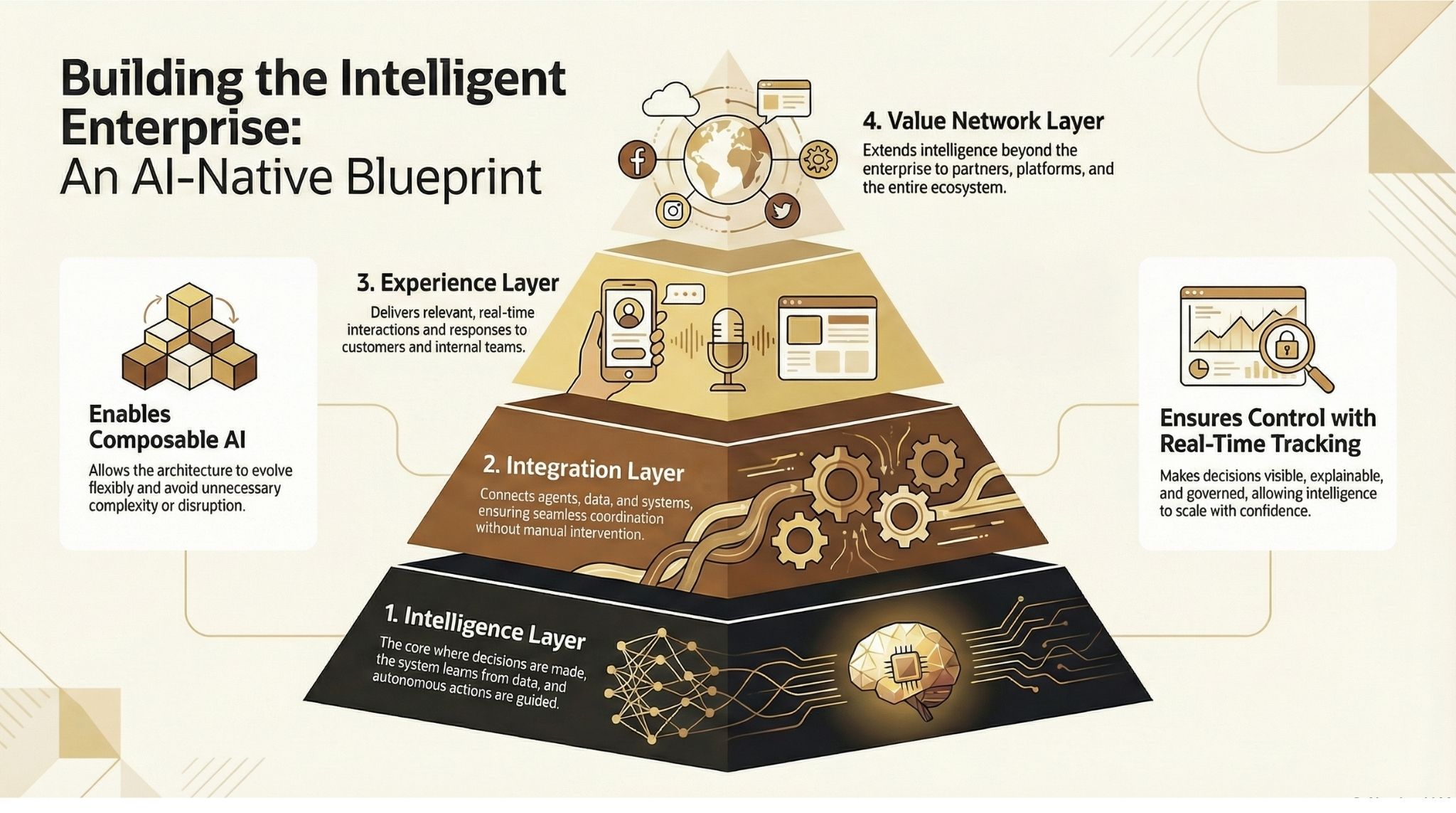
X-OS creates a foundation where intelligence flows seamlessly. It integrates experience, value networks, and operational systems into a cohesive design.
This is how enterprises evolve into truly AI-native organizations. It is capable of scaling knowledge and decisions. All of these without constant human intervention.
Emerging Trends and Innovations
The intelligence-first era is shaping new business models and operational practices.
Some of the trends leading this transformation include:
◉ Multi-agent collaboration: systems communicate and coordinate autonomously. It is similar to how Tesla's fleet shares learning across vehicles.
◉ Composable intelligence: Modular AI components enable enterprises to scale specific capabilities. It does so without overhauling the entire architecture.
◉ Real-time lineage tracking in AI - Leaders can see how decisions are made. It increases trust and transparency across operations.
◉ Human-centric augmented intelligence - People guide and collaborate with AI rather than being replaced. It ensures decisions remain ethical and contextually informed.
These innovations reflect a broader shift from digital transformation to intelligence-first design. A place where enterprise value grows exponentially as systems learn, adapt, and act.
Compounding Growth and Exponential Outcomes
Enterprises that embrace the X-OS framework see outcomes that compound over time. Learning systems improve decision speed. They optimize resource allocation and adapt to market shifts.
What's the best part? Companies see progress without waiting for manual intervention.
Global examples highlight the potential:
◉ IBM – They use X-OS-inspired architectures to coordinate AI-driven insights. It is applied across cloud, consulting, and software services.
◉ Tesla - Fleet learning continuously improves vehicle performance. It effectively translates into faster product innovation cycles.
◉ Microsoft - Integrates AI into productivity tools and cloud platforms. The company streamlines operations for global enterprises.
By embedding intelligence at every layer, organizations move beyond incremental gains. They unlock an exponential enterprise operating system. It is where growth, innovation, and adaptability scale naturally.
Designing Enterprises for the Intelligence-First Era
Enterprises are reaching an inflection point. Digital transformation improved speed and efficiency. However, it stopped short of creating intelligence that can learn, adapt, and act at scale.
The shift centers on how decisions are made. It impacted how systems coordinated and how value compounds over time.
An intelligence-first approach reframes enterprise design around continuous learning. It enhances autonomous execution and human guidance. The change moves organizations beyond tools and platforms.
It focuses on a shift toward operating models built for change. This is where digital tools and AI-driven intelligence become more than a strategy. It becomes a capability.
At XBD Consulting, enterprise transformation is treated as a system-level redesign. Through the X-OS blueprint, intelligence, integration, experience, and value networks align into one operating fabric.
Our foundation will help enterprises scale trust, resilience, and decision velocity without losing control.
We believe that the future belongs to organizations that design intelligence to grow with them. It won't be ruled by systems that wait to be told what to do.
So, be the change.
Design intelligence right, and the enterprise never stops evolving.
FAQs:
1. Is digital transformation still worth investing in today?
Yes, digital transformation is still worth investing in if you build it on the right foundation. It will help you modernize operations and improve efficiency. However, without an intelligence-first layer, your transformation will eventually stop delivering strategic value.
2. How is intelligence-first transformation different from AI adoption?
Intelligence-first transformation changes how your organization makes decisions. Instead of adding AI on top of existing workflows, you redesign systems to operate autonomously. It is where workflow orchestration with agents replaces simple automation.
3. What industries benefit most from intelligence-first models?
You see the strongest impact in industries with complex decisions and constant change. Manufacturing, financial services, healthcare, and logistics benefit the most. It is possible because intelligence adapts in real time.
4. Can mid-sized enterprises adopt intelligence-first strategies?
Yes, you do not need enterprise-scale budgets to bring the change. You can adopt intelligence-first strategies incrementally. However, you would need the right architecture. It will allow you to scale intelligence without overwhelming your organization.
5. How long does it take to see value from intelligence-first initiatives?
You begin to see value once intelligence improves decision-making across workflows. Early impact often appears within months when coordination and insight improve.
6. What skills do leaders need in an intelligence-first organization?
You need leaders who can guide systems rather than micromanage execution. Judgment, context-setting, and oversight become more important. Such an approach strengthens human-centric augmented intelligence.
7. How do agentic AI systems differ from traditional automation?
It is quite different from traditional automation, which follows predefined rules. They stop when conditions change. Agentic systems reason, collaborate, and adapt as situations evolve. An Agentic AI mesh allows these agents to coordinate decisions across the enterprise.
8. What role does governance play in intelligent enterprises?
Governance becomes more important as systems gain autonomy. You need visibility into how decisions are made. You need to see how intelligence learns over time. Well-designed AI governance frameworks protect trust while still enabling scale.
9. How do you prevent AI-driven systems from creating risk?
You prevent risk by increasing transparency. Clear oversight helps you understand why systems act the way they do. Real-time lineage tracking in AI allows you to intervene before small issues grow.
10. What metrics indicate intelligence maturity in an organization?
You need to understand that maturity is growing. It is when the decision quality improves across teams. Manual coordination decreases while adaptability increases. At scale, your organization begins operating like an exponential enterprise operating system driven by learning.